Crown Hotel council
The LuminariesThe Crown Hotel council is an improvised assembly of men drawn into the mysteries surrounding January 14: the night Crosbie Wells died, Anna Wetherell nearly died, Emery Staines disappeared, and Francis Carver sailed away. Called together to compare what they knew, its members form not a court or a unified investigative body but a fragile network of witnesses, beneficiaries, and intermediaries. Their shared secret briefly makes them allies, even as the gaps and distortions in their knowledge turn inquiry into suspicion.
Formation and membership
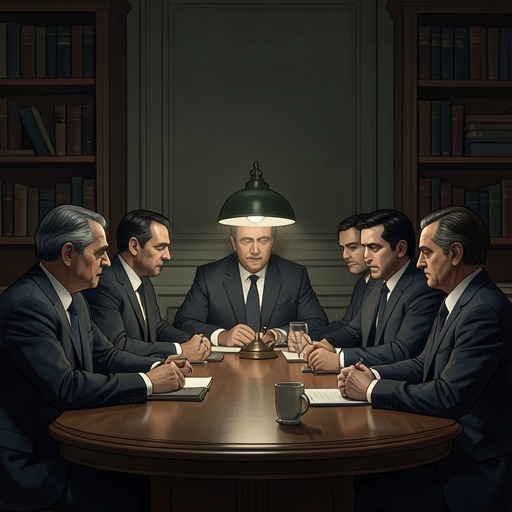
Charlie Frost proposed that a small group meet after nightfall at the Crown Hotel to pool information and discuss the case. The first invitation was to the men who had been present in Quee Long’s hut that afternoon, with Edgar Clinch, who had bought Wells’s estate, and Joseph Pritchard, whose laudanum had been found in Wells’s cottage, added to the group. Harald Nilssen vouched for Pritchard, and Frost vouched for Clinch. Frost’s choice to restrict the gathering to a select few provoked Benjamin Löwenthal, who regarded the exclusion as a moral error.
Löwenthal had no authority to alter the invitation, but did so anyway, extending it to Te Rau Tauwhare and Cowell Devlin as an act of reproach toward Frost. At the meeting, he explained its purpose to the men already assembled. Devlin accepted only after a long pause: he had concealed a deed of gift taken from Wells’s stove inside his Bible, between the Old and New Testaments, and was weighing whether the council offered the right occasion to reveal it. The document thus entered the room as a possible piece of evidence before Devlin had decided to produce it.
The gathering eventually comprised twelve men, with Walter Moody also present. Its members had sharply different connections to the events: Tauwhare had been Wells’s loyal friend; Frost had facilitated the sale of Wells’s property; Clinch had purchased it; Nilssen had discovered the fortune in the cottage; and Pritchard had supplied the laudanum found there. Thomas Balfour was associated with Alistair Lauderback, whose shipping crate had disappeared. Aubert Gascoigne had secured Anna’s bail and found gold in her orange dress. Dick Mannering and Ah Quee were adversaries tied to the Aurora claim and the gold removed from Anna’s gowns; Ah Sook was an opium seller and former associate of Carver. Devlin had buried Wells. Moody, who had arrived in Hokitika only weeks before, was still piecing together how these separate histories intersected.
What the council knows—and cannot know
As the meeting continues past midnight, Balfour’s account supplies a connective narrative, but not a tidy or complete one. It is disjointed, repeatedly interrupted, and difficult for Moody to order. Moody looks around the smoking room and recognizes that every man there has some association with the January events, yet the most consequential figures are absent: Carver, Lauderback, Lydia Wells, Anna, Staines, and George Shepard. The council is therefore assembled around the edges of the mystery, trying to infer the actions of people who are not there to answer for themselves.
Moody reconstructs part of the story from what he hears. Carver had taken the Godspeed from Lauderback and used a missing crate as leverage; the crate held a trunk with roughly four thousand pounds in gold sewn into five dresses. Carver later advertised for its return under the name Crosbie Francis Wells, supported by a birth certificate whose presence in his hands remained unexplained. Meanwhile, the real Crosbie Wells had secretly accumulated a fortune of his own, found after his death in his cottage. The gold in the dresses followed another route: Ah Quee removed it from four gowns while Anna, heavily affected by opium, slept, and stamped the retorted gold with the Aurora name. The remaining gold was later found by Anna in her orange dress.
These strands make the council’s method both useful and precarious. By bringing together people who witnessed different parts of the same chain, it can expose relationships between apparently separate events. But no single account supplies the whole truth, and Moody recognizes that the men’s involvement is too varied for a simple division between guilty and innocent. The actual agents of the larger secrets, he suspects, are largely elsewhere. Their absence leaves the council to work from reports, conjectures, and information that has travelled through several hands.
Secrecy, solidarity, and exclusion
The men swear on their honour to keep the council secret. Three weeks later, that promise has given them a quiet sense of fellowship: they exchange greetings and recognize one another with the grave familiarity of members of a guild. Their bond rests less on agreement than on a shared suspicion of figures outside their circle. As they discuss Carver, Lauderback, Shepard, Lydia, Anna, and Staines, their explanations grow more fanciful even though no new information has arrived. The secret strengthens their association, but it also helps turn unconfirmed theories into something like collective conviction.
That solidarity is unequal. Ah Sook and Ah Quee understand only part of Balfour’s fast, poetically accented account; Ah Quee’s English is even more limited than Ah Sook’s. The other men have little patience for requests from Chinese members to clarify what has been said. The two leave with an incomplete grasp of the discussion, and neither follows the others to inspect the wreck of the Godspeed. Ah Sook consequently continues to believe that Carver sailed for Canton and will not return soon. The council’s claim to shared knowledge therefore conceals an uneven distribution of access: the men are in the same room, but they do not receive the same information on equal terms.
The setting also gathers together interests shaped by colonial dispossession. Tauwhare’s presence is not merely another clue in the case. Poutini Ngāi Tahu land had been sold to the Crown for three hundred pounds, leaving the people confined to a much smaller area, while prospectors and purchasers profited from land and gold. Wells had bought a hundred acres in the Arahura Valley from the Crown, on land adjoining the portion to which Poutini Ngāi Tahu had been restricted. Tauwhare had shared knowledge and friendship with Wells, yet could not claim the cottage or land after Wells’s death; it had already passed to Clinch by purchase. The council brings these men together to discuss a mystery, but does not erase the unequal legal and economic positions from which they approach it.
Leakage and narrative significance
The council’s secrecy proves vulnerable almost immediately. Nilssen had disclosed to all twelve other men the secret of his arrangement with Shepard, and later finds himself unable to explain how Lauderback learned of the commission. He considers whether Balfour or Löwenthal betrayed him, but the information had already been shared with the entire council. The oath creates no secure boundary around knowledge; it multiplies the number of people who can pass it on, deliberately or otherwise.
The council’s importance lies in this tension between connection and uncertainty. It is a practical attempt to assemble scattered evidence, but the novel presents it through the disorder of Balfour’s telling and Moody’s effort to put events back into sequence. The meeting makes relationships visible without making them transparent. It builds a temporary fellowship across divergent interests, while revealing how easily secrecy becomes suspicion and how exclusion shapes what the group can know. Its members leave not with a settled verdict, but with a more entangled account of the events—and with a shared secret that is already beginning to fray.